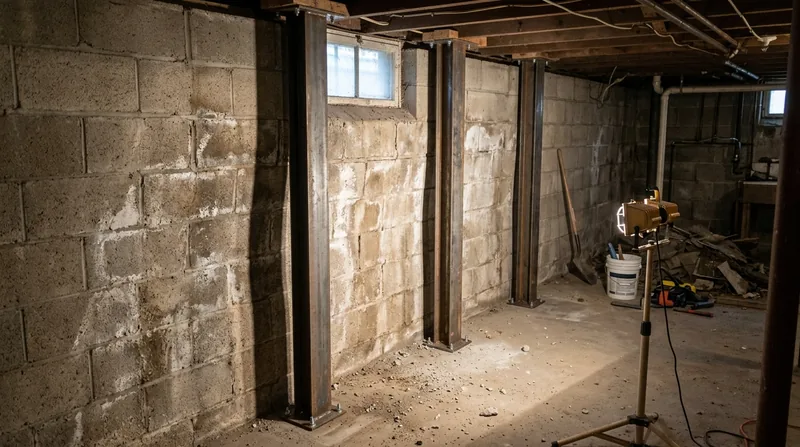




Waterloo sits on both banks of the Cedar River in Black Hawk County, and the ground under most of this city is loess silt and glacial till over clay that holds spring meltwater and then releases it slowly against foundation walls. The 1900s to 1930s bungalows and foursquares in Sunnyside, the Rath area, and the streets near downtown often carry full basements under brick walls with stone or early block foundations, and that masonry moves when wet soil pushes from behind. If you are searching for Bowing Wall Repair in Waterloo, you already know the symptom: a wall that leans in, a horizontal crack at mid-height, or a floor that has started to pull away from the plate. We diagnose the actual pressure path, not just the crack, and we match the fix to the severity of the movement. Start with a free basement inspection so the wall gets measured before anyone quotes a repair.
Why Bowing Walls Show Up So Often in Waterloo's Older Neighborhoods
Bowing is a pressure story, and Waterloo writes it every winter and spring. Glacial clay soil swells as snowmelt and heavy spring rain soak in, then pushes laterally against a block or brick wall that was never engineered for that load. Freeze-thaw cycles open the mortar joints, water gets in, and the wall starts to rotate inward around its base. The 2008 Cedar River flood also left lower neighborhoods with saturated soils that never fully drained.
- Horizontal cracks at mid-wall height point to hydrostatic pressure from saturated soil, not to a settling foundation.
- Walls that lean in at the top with a straight base usually indicate the floor joists are holding the top while the middle bows.
- White efflorescence on the block face means water is moving through the masonry and depositing salts as it dries.
- Clay tile drains from the 1920s and 1930s are often collapsed or root-filled, so the footing drain no longer relieves the soil.
- Downspouts that dump within three feet of the wall keep the same soil wet all year, which accelerates the movement.
None of these symptoms fix themselves, and a wall that moves a quarter inch this year can move an inch the next. The right repair depends on whether the wall is bowing, sliding, or tipping, and each one takes a different anchor or strap pattern.
Key info: A 1920s foursquare near downtown Waterloo with a stone foundation and a horizontal crack at mid-wall is a classic bowing case. We have pulled carbon fiber straps across that same wall type on blocks along the Rath area, and the strap only works when the soil pressure behind it is also relieved with proper drainage.
For the official word on structural repair permits in this jurisdiction, check the City of Waterloo building department before work begins, because thresholds and inspection requirements vary and must be verified locally.
How We Stabilize a Bowing Wall in Waterloo, Step by Step
We do not sell one system to every wall. The first visit is a measurement visit: we check plumb with a level and a string line, map the crack pattern, probe the soil at the footing, and confirm whether the drain tile is still moving water. From there we pick carbon fiber straps, steel I-beams, or wall anchors based on how far the wall has moved and how much soil is pushing.
- We document the wall with photos and a plumb reading so the movement is measured, not guessed.
- We relieve the pressure source first, because a strap on a wet wall is a bandage, not a repair.
- We excavate or work from inside depending on the system, and we keep the basement usable during the job.
- We install carbon fiber straps epoxied to the block face, or steel I-beams set into the footing and bolted to the joists, or anchors driven into stable soil outside.
- We seal the crack line and parge the wall face so water cannot re-enter the repaired zone.
- We re-check plumb at the end and hand you the readings so you can track the wall over time.
Every job ends with a written record of the starting position and the finished position, because a stabilized wall should be provable, not just promised.
Key info: On a 1950s ranch in Evansdale with a poured wall bowing about an inch and a half, we used steel I-beams because the wall was poured, not block. On a block wall in Hudson with a smaller bow, carbon fiber straps were enough once the footing drain was reconnected. Same symptom, different fix, and the measurement decides which one.
If the wall is moving because the perimeter drain has failed, the repair has to include drainage work, and you can read how we handle that on the drain tile repair page.
Bowing Wall Repair Methods We Use in Waterloo
Four systems cover almost every residential bowing wall in this city, and the choice comes down to wall material, movement amount, and whether the soil pressure can be relieved from inside or has to be addressed outside. We explain the tradeoffs before you commit to one.
| Approach | Description | Best for |
|---|---|---|
| Carbon fiber straps | Epoxied vertically to the block face and anchored top and bottom, they resist further inward movement without excavation. | Block walls with moderate bowing and a stable footing. |
| Steel I-beams | Beams set into the footing and bolted to the floor joists to brace the wall from floor to plate. | Poured walls and heavier movement where straps alone are not enough. |
| Wall anchors | Anchor plates driven into stable soil outside pull the wall back through rods tied to interior plates. | Walls that have tipped or slid and need to be pulled back toward plumb. |
| Drainage relief plus sealing | Interior perimeter drain and crack sealing remove the water pressure the wall is fighting. | Any bowing wall where the footing drain has failed or the soil stays saturated. |
The structural system and the drainage work are usually done together, because a braced wall still has to stop taking water.
Bowing Wall Repair Cost in Waterloo: What to Expect
Pricing starts at $600 for a limited crack-and-strap scope, and most real bowing wall jobs land well above that once the system and the drainage are included. A single wall with moderate movement and working drainage is a different number than a wall that has tipped two inches over a failed footing drain. We quote after measuring, not before.
- The length of the bowed wall and the number of straps or beams drive the material cost more than anything else.
- Access matters: a wall behind a finished basement or a tight side yard takes longer than an open wall.
- Whether the footing drain has to be replaced adds a separate scope on top of the structural repair.
- Poured walls and stone foundations take different hardware than standard block, and that changes the labor.
- Getting two or three estimates is smart, because a quote that ignores the water source is not a complete quote.
We put the full breakdown on the pricing page so you can compare line by line instead of guessing from a lump sum.
Bowing Wall Repair Near Me: How to Choose a Contractor Near Waterloo
Ask three questions before you sign anything: are you licensed and insured, what is the measured plumb reading today, and what is the water source behind the wall. A contractor who cannot answer the second and third is guessing. Permits are commonly required for structural foundation repair in this jurisdiction, and the rules vary, so confirm with the local building department and ask whether the contractor pulls the permit.
- Ask for a certificate of insurance and confirm the license before work starts.
- Get two or three written estimates that state the system, the linear feet, and the drainage scope separately.
- Ask for references from jobs in Waterloo or nearby towns done in the last two years.
- Confirm who pulls the permit and who schedules the inspection.
- Check whether any HOA or historic district rule applies to exterior excavation or anchor plates.
If a contractor will not put the plumb reading and the drainage scope in writing, keep looking. You can reach us through the contact page to set up the measurement visit.
When Bowing Wall Repair Is the Right Call, and When It Is Not
A hairline vertical crack with no movement is a sealing job, not a structural one, and we will tell you that plainly. Bowing repair is for walls that have actually rotated or cracked horizontally, where the block or poured face is no longer in line. If the wall is straight and the only problem is water, the answer is drainage and sealing, not straps.
Key info: In the newer subdivisions around Cedar Falls and on the walkout lots in Elk Run Heights, we sometimes find a wall that looks bowed but is actually a grading problem pushing water against the foundation. Fix the grade and the downspout extension, and the wall stops moving. We check that before we quote hardware.
For walls that only show a crack and no rotation, the foundation crack repair page covers the injection options, and for the wet wall behind the bow, the basement waterproofing page explains how the water gets managed.
Bowing Wall Repair in Waterloo: Pricing Guide
| Service | Price | Details |
|---|---|---|
| Crack sealing and strap starter scope | Starting at $600 | Covers a short crack run and one strap location, with movement measured and documented before work starts. |
| Carbon fiber strap system | Starting at $1,400 | Priced per strap and linear foot of bowed wall, with block face prep and epoxy anchoring included. |
| Steel I-beam bracing | Starting at $2,200 | Beams set into the footing and tied to the joists, priced by wall length and beam count. |
| Wall anchor system | Starting at $2,800 | Exterior anchor plates and interior rods for tipped walls, priced by anchor count and excavation access. |
| Drainage relief add-on | On estimate | Interior perimeter drain or footing drain replacement quoted after the water source is confirmed on site. |
| Free inspection and estimate | Free | Plumb reading, crack map, and written scope at no cost, with response within 24 hours at (319) 505-8848. |
Indicative pricing, the exact cost depends on square footage, finish, and site access. Free personalized estimate within 24h at (319) 505-8848.


